



Changing engine oil is one of the most important car maintenance tasks. Fresh oil lubricates moving engine components, helps control heat, carries contaminants toward the oil filter and reduces friction between metal surfaces. Oil keeps engine parts lubricated, cool, and protected. When oil becomes old or heavily contaminated, it may no longer protect the engine effectively. The result is increased engine wear, overheating, and eventually, the kind of repair bill that no Pakistani car owner wants to see.
For Pakistani drivers, oil condition can be affected by extreme summer temperatures, dusty roads, traffic congestion, short journeys and long periods of engine idling. These conditions can place additional stress on the engine, particularly in busy cities such as Karachi, Lahore, Rawalpindi, Faisalabad and Peshawar.
The good news is that changing your car’s oil is one of the most straightforward maintenance tasks you can do yourself. You do not need a professional workshop, expensive equipment, or years of mechanical experience. With the right approach you can do it by yourself without any extensive work or you can approach experts of Saif Traders for oil changing.
Key Takeaways
In this professional guide you will learn:
- Why you mobile oil for your vehicles and why you need to change it after a certain limits.
- How to change the mobile oil with proper experts guide.
- What tools kit is need to change the vehicle oil.
- What points to be considered to change the oil and filter with proper instructions.
- What steps you have to follow for oil changing.
- A comparison between changing the oil yourself and getting professional help.
Why Regular Oil Changes Matter
Engine oil does not remain clean forever. During normal operation, it is exposed to heat, moisture, fuel residue, dust and tiny particles produced inside the engine. Pakistan’s driving conditions are genuinely hard on engine oil. Stop-and-go traffic in Lahore, Karachi, and Rawalpindi, combined with summer temperatures that regularly exceed 40°C, breaks down oil faster than the mild climates most international maintenance intervals are designed for. Delaying an oil change can contribute to sludge formation, increased friction, higher operating temperatures and accelerated engine wear.
Why You Need to Change the Oil
Regular oil and filter changes can support:
- Smoother engine operation
- Better lubrication during startup
- Cleaner internal components
- Reduced friction and wear
- Improved engine reliability
- Longer engine service life
There is no universal oil-change interval for every car. Manufacturers provide different recommendations according to the model, engine and operating conditions. Vehicles used under severe conditions may require more frequent servicing.
How Long to Change Oil in Car
For Pakistani conditions, a practical guideline is to change conventional (mineral) oil every 5,000 kilometres and synthetic oil every 8,000–10,000 kilometres. If your car runs mostly on city roads with heavy traffic, err on the shorter end of that range.
Tools and Supplies Needed For Oil Changing
A basic DIY oil change normally requires:
- Correct engine oil
- Vehicle-compatible oil filter
- New drain-plug washer or gasket
- Socket wrench and correct socket
- Oil-filter wrench
- Drain pan
- Funnel
- Protective gloves
- Safety glasses
- Wheel chocks
- Jack stands or vehicle ramps, when lifting is necessary
- Clean cloths or paper towels
- Sealed container for used oil
Never assume that oil filters are universal. A filter made for one engine may have a different thread size, sealing surface, pressure setting or physical shape.
Important Notice: Before buying supplies, note the car’s make, model, engine size and manufacturing year. For example, two Toyota Corolla variants from the same year may use different oil capacities or filters if their engines are different.
How to Choose the Correct Oil and Filter
This is where many beginners make their first mistake: buying the wrong oil grade. The safest source for oil information is the owner’s manual. It normally states the required viscosity, performance specification and approximate refill capacity.
A label such as 5W-30 describes the oil’s viscosity behaviour. The number before “W” relates to its flow at lower temperatures, while the second number indicates its viscosity at normal operating temperatures. It does not simply mean that one oil is “thicker” or “better” than another.
Drivers should not select oil only because a mechanic, shopkeeper or friend recommends it. Check:
- SAE viscosity, such as 0W-20, 5W-30 or 10W-40
- API, ACEA or manufacturer-required specification
- Petrol, diesel, turbocharged or hybrid compatibility
- Engine mileage and mechanical condition
- Recommended oil capacity
Synthetic oil generally offers strong performance across temperature changes and demanding operating conditions, but conventional, synthetic-blend and full-synthetic oils should still meet the specifications requiccred by the manufacturer. Always follow the manual rather than choosing oil by brand or price alone.
In Pakistan especially in Lahore, buy oil and filters from an authorised dealer like Makki Oil Store and Lube House. Check the bottle seal, batch details, printing quality and verification code where available because counterfeit lubricants can create serious engine risks.
Important Notice: Saif Traders is the authorized dealer of tyres and alloy rims, we do not promote other products and it is your responsibility to check it first and then buy for your own experience.
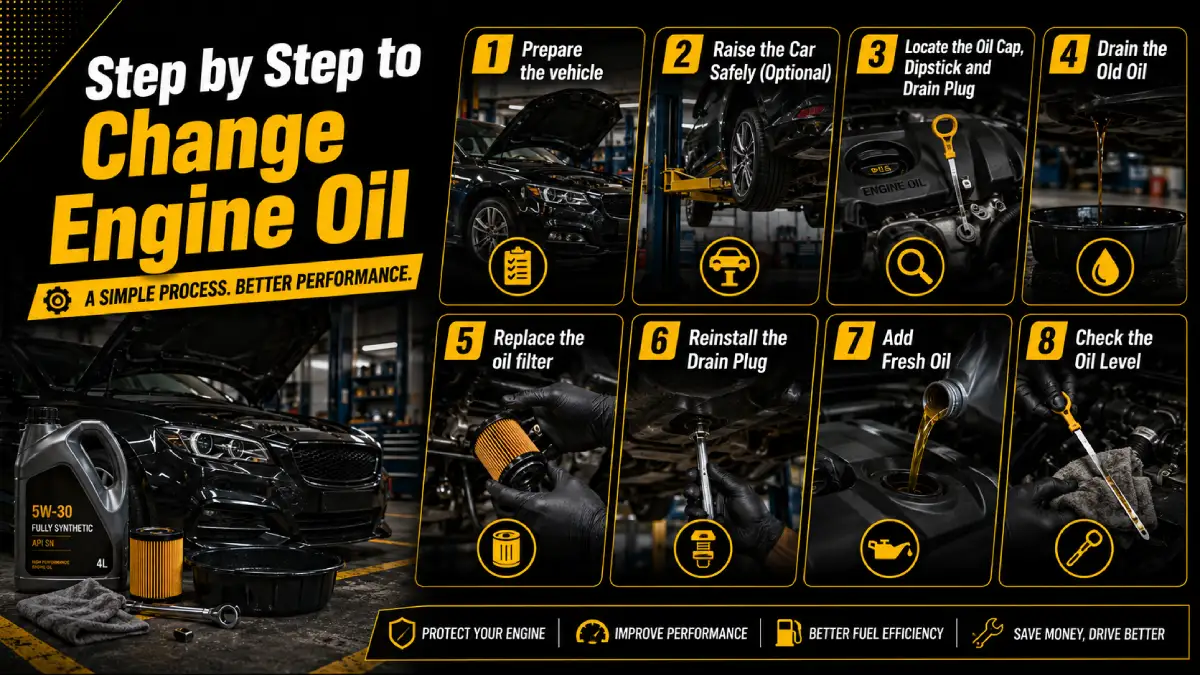
Step by Step to Change Engine Oil
Prepare the vehicle
Park on a level, solid surface. Apply the parking brake. Start your car and let it run for two to three minutes, then switch off. Warm mobile oil drains faster and more completely than cold oil.
Point to be Noted: Hot oil can burn skin. Wait at least 15–20 minutes after switching off before getting underneath the car.
Raise the Car Safely (Optional)
Some cars like Suzuki Cultus 2017, Suzuki Swift, Honda Civic, Toyota Yaris and Honda Vezel etc need to lifted for oil changing. On the other hand, Suzuki Alto, Wagon R, Mehran, Bolan, Ravi, Toyota Corolla, APV have enough ground clearance to access the drain plug without lifting. Others require ramps or jack stands.
Never crawl beneath a vehicle supported only by a hydraulic or scissor jack. A jack is designed to lift the car, not safely hold it while someone works underneath. Use approved lifting points and secure the vehicle with properly rated jack stands. Pennzoil’s instructions similarly warn against working under a vehicle held only by a jack.
Locate the Oil Cap, Dipstick and Drain Plug
- Open the bonnet and identify the engine-oil filler cap and dipstick. Under the engine, locate the oil pan and its drain plug.
- Do not confuse the engine-oil drain plug with the transmission drain plug. When uncertain, consult the owner’s manual or a vehicle-specific service diagram before loosening anything.
Drain the Old Oil
- Position the drain pan below the plug, allowing for the oil to flow outward when the plug is first removed.
- Loosen the plug carefully with the correct socket. Finish removing it by hand while keeping pressure against it, then pull it away quickly. Allow the old oil to drain until only occasional drops remain.
- Inspect the drain plug and replace its crush washer or sealing gasket when required.
Safety Notice: When changing engine oil, never work underneath a vehicle supported only by a jack. The UK Health and Safety Executive recommends using properly rated axle stands, ramps or a vehicle lift on firm, level ground. Always follow the lifting points and instructions provided in the vehicle owner’s manual. Read the official HSE guidance.
Replace the oil filter
- Move the drain pan underneath the oil filter. Loosen the old filter with an oil-filter wrench, then remove it by hand.
- Check that the old rubber gasket came off with the filter. If it remains stuck to the engine and a new filter is installed over it, the double gasket can cause a serious leak.
- Apply a light film of fresh engine oil to the new filter’s rubber seal. Install it by hand until the gasket touches the mounting surface, then tighten it according to the filter or vehicle instructions. Many spin-on filters require only a specified fraction of a turn after contact. Avoid excessive tightening.
- Never reuse an old oil filter during a routine oil change.
Reinstall the Drain Plug
- Clean the drain opening and reinstall the plug with its new washer. Tighten it to the manufacturer’s torque specification using a torque wrench where possible.
- An undertightened plug may leak. An overtightened plug may damage the threads, crush the oil pan or make the next oil change difficult.
Add Fresh Oil
- Place a funnel in the oil-filler opening. Add slightly less than the complete stated capacity, particularly when the exact amount remaining inside the engine is unknown.
- Reinstall the filler cap. Start the engine for approximately 20 to 30 seconds while checking that the oil-pressure warning light goes out normally. Switch off the engine and wait several minutes for the oil to settle.
Check the Oil Level
- Remove the dipstick, wipe it clean, insert it fully and remove it again. The oil level should sit between the minimum and maximum marks, ideally near the upper mark without exceeding it.
- Add small amounts when necessary. Too little oil can reduce lubrication, while too much oil may cause foaming, pressure problems, smoke or seal damage.
Important Points: Along with changing the engine oil, drivers should regularly inspect their tyres and alloy rims for low pressure, uneven wear, cracks or damage. To buy the best tyres in Lahore or anywhere in Pakistan, simply contact us “+924235160364” for expert guidance and reliable options. Saif Traders are properly functional from almost 30+ years and earned a perfect name in Pakistanis market.
DIY Oil Change vs Professional Workshop in Pakistan
A workshop oil change in Pakistan typically costs between Rs. 1,500 and Rs. 4,500 depending on the oil grade used and the workshop type. This usually covers labour and sometimes includes the filter. Doing it yourself costs only the price of the oil and filter. Its typically cost around Rs. 1,800–3,500 for quality synthetic or semi-synthetic oil and a new filter. The saving per oil change is modest, but across four to five changes per year it becomes meaningful.
Common Oil-Change Mistakes to Avoid
Beginners should watch for these common errors:
- Using an incorrect oil viscosity
- Buying the wrong filter
- Forgetting the new drain-plug washer
- Leaving the old filter gasket attached
- Overtightening the filter or drain plug
- Adding too much engine oil
- Starting the engine before refilling
- Working beneath a car supported only by a jack
- Ignoring leaks after the engine starts
If the oil warning light remains on, switch off the engine immediately. Check the oil level, drain plug and filter area. Do not continue driving until the cause is identified.
Frequently Asked Questions
Q: Can I change car oil at home in Pakistan without a lift?
Yes. If your car has enough ground clearance you can do it easily. Many cars like a Toyota Corolla, Honda City, or Suzuki Cultus have enough clearance and it is easy for you to change the oil. For lower cars, basic ramps costing Rs. 2,000–4,000 from auto parts shops make the job safe and comfortable.
Q: How do I know my car needs an oil change?
The most reliable indicators are mileage interval, a dark black colour on the dipstick, the oil warning or maintenance light on the dashboard, and any ticking or rattling noise from the engine at startup. Do not wait just change it from authorized dealer.
Q: How long does an oil change take for a beginner at home?
Your first time, allow 45 minutes to an hour. Once you have done it two or three times with your specific car, the process takes 25–35 minutes comfortably.
Is changing car oil difficult for a beginner?
No. It is manageable with the correct tools and instructions. The biggest risks are lifting the car incorrectly, using the wrong oil and overtightening parts.
Should the engine be hot or cold?
The engine should be slightly warm, not extremely hot. Warm oil drains faster, but very hot oil can cause serious burns.
Do I need to lift the car?
It depends on ground clearance. Cars such as the Suzuki Alto, Wagon R and Toyota Corolla may provide enough access, while lower vehicles may require ramps or jack stands.
Can I work under a car supported by a jack?
No. A jack can slip or fail. Always use properly rated jack stands or vehicle ramps on a solid, level surface.
Should I replace the oil filter every time?
Yes. A new filter prevents contaminants from the old filter from circulating through the fresh engine oil.
Are all oil filters the same?
No. Filters differ in size, thread, pressure rating and sealing design. Select one according to the car’s model, year and engine type.
Which engine oil is best for Pakistani weather?
Use the viscosity and specification recommended in the owner’s manual. Hot weather alone does not mean every car should use thicker oil.
Can I switch to synthetic oil?
Yes, provided the synthetic oil meets the manufacturer’s required viscosity and performance specifications.
How tight should the oil filter be?
Most spin-on filters should be tightened by hand until the gasket contacts the surface, followed by the additional turn stated on the filter.
What if the oil filter is stuck?
Use a proper filter wrench or filter socket. Avoid piercing it with a screwdriver because the filter body may tear.
How tight should the drain plug be?
Tighten it to the manufacturer’s torque specification. Overtightening can strip the oil-pan threads, while undertightening can cause leaks.
Why is oil leaking after an oil change?
Common causes include a loose filter, damaged filter gasket, missing drain-plug washer, loose drain plug or spilled oil.
What happens if too much oil is added?
Excess oil can foam, increase pressure, produce smoke and damage seals. Remove the extra oil until the dipstick shows the correct level.
What happens if too little oil is added?
Low oil can reduce lubrication and cause severe engine wear. Switch off the engine and add the correct oil before driving.
Why is the oil warning light still on?
Stop the engine immediately. Check the oil level and inspect the filter and drain plug for leaks. A pressure warning is different from a service reminder.
Why does new oil become dark quickly?
Fresh oil can darken as it collects carbon and contaminants, especially in diesel engines. Dark colour alone does not mean the oil has failed.
Can fake engine oil damage a car?
Yes. Counterfeit oil may provide poor lubrication and cause deposits or engine damage. Buy from authorised dealers and check seals, batch codes and verification labels.
Can I reuse the old drain-plug washer?
It is better to install a new crush washer. Reusing a damaged or flattened washer can cause a slow oil leak.
Can changing oil at home void the warranty?
Usually not when the correct oil, filter and procedure are used. Keep receipts and record the service date and mileage as proof of maintenance.
What should I check after changing the oil?
Start the engine briefly, confirm the oil warning light turns off, inspect for leaks and recheck the dipstick after the engine has been switched off for several minutes.